Grip Texture and Bar Diameter: The Science Behind 33.7 mm vs. 42.4 mm Steel Pipes
When architects, facility managers, and site planners specify outdoor fitness equipment, bar diameter is rarely the first item on the checklist. It should be. The diameter of a steel pipe determines whether a user can close their hand around it, how much friction the surface generates under wet conditions, and whether the structural element can withstand the dynamic loads imposed by real athletic training. Getting it wrong means equipment that looks correct but performs poorly — and potentially fails a DIN EN 16630 inspection.
This article examines the two standard pipe diameters used in professional outdoor calisthenics equipment — 33.7 mm and 42.4 mm — and explains the engineering logic that governs which diameter belongs at which station.
Why Diameter Is a Functional Specification
A steel pipe's outer diameter governs three independent variables simultaneously: grip circumference, structural moment of inertia, and surface area available for coating adhesion. These variables interact differently depending on the exercise being performed.
For pull-up stations, the dominant variable is grip circumference. The human hand has a finite span. When the bar diameter exceeds the hand's comfortable wrap radius, the fingers cannot overlap the thumb, grip strength drops, and the forearm flexors compensate with excessive tension — increasing injury risk and reducing training efficiency. Biomechanical research consistently places the optimal pull-up bar diameter between 28 mm and 38 mm for the majority of adult hand sizes. The 33.7 mm nominal pipe diameter (a standard EN 10255 / ISO 65 dimension) sits precisely in this range.
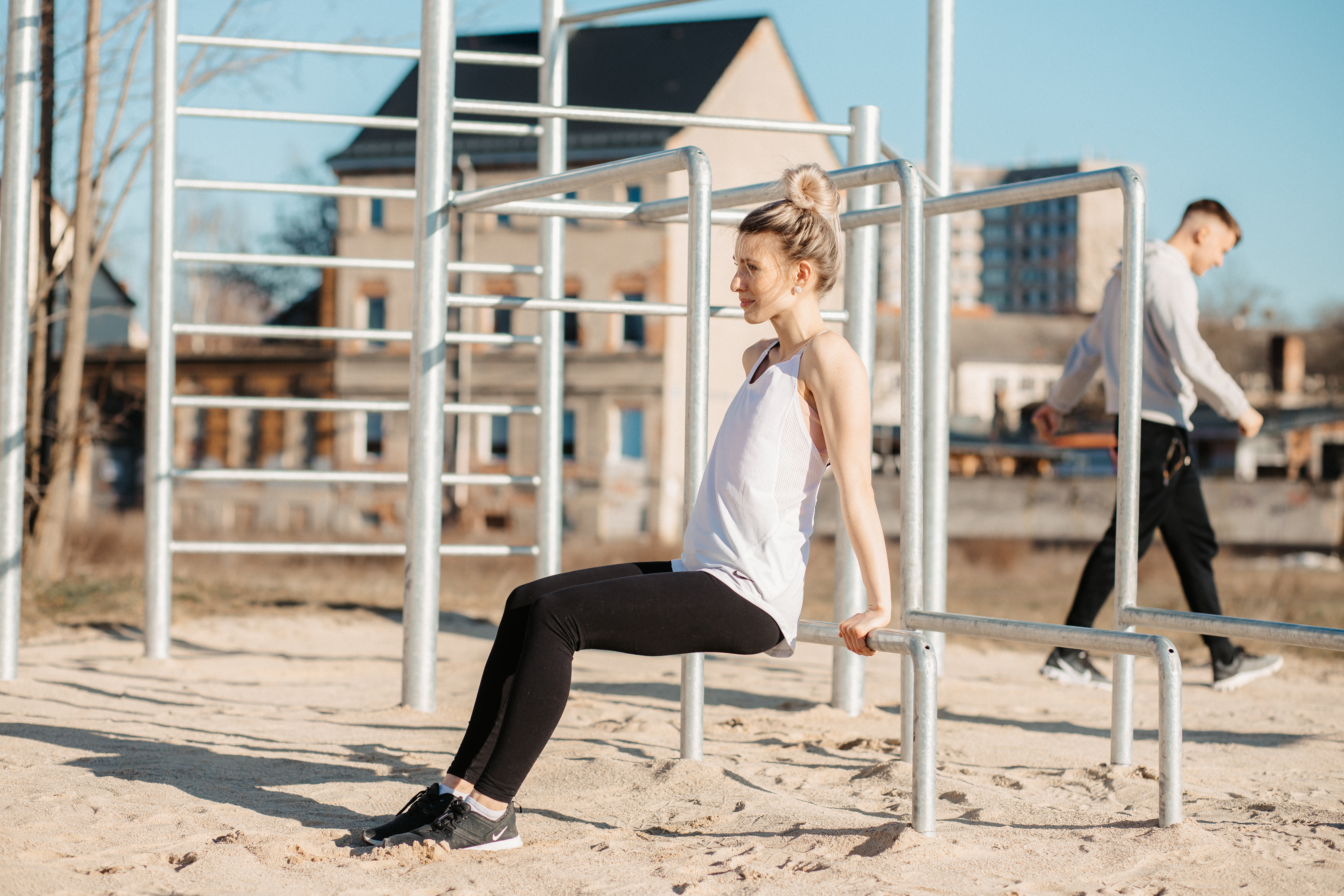
For dip bars and structural cross-members, the dominant variable shifts to rigidity. A dip movement applies a downward force at the midpoint of a horizontal span. The pipe must resist bending without deflection that would alter the exercise geometry or, in the worst case, cause permanent deformation. The 42.4 mm nominal diameter provides a significantly higher second moment of area, making it the correct choice for load-bearing horizontal elements.
The 33.7 mm Bar: Pull-Up, Knee-Raise, and Grip Stations
The 33.7 mm outer diameter is the workhorse of calisthenics equipment. It appears at pull-up stations (Exercise Field B in the BARbara system), simplified pull-up bars (Field C), and the Snake Bar used for knee raises (Field F). Each of these stations demands that the user maintain a secure grip through a full range of motion — often while the body is swinging or rotating.
Grip Closure and Force Transfer
At 33.7 mm, an adult hand with average span can achieve near-complete finger-to-thumb overlap. This closure is critical because grip force is generated by the flexor digitorum superficialis and profundus muscles acting against a fixed-diameter cylinder. A smaller diameter concentrates pressure on fewer contact points; a larger diameter spreads the load but prevents full closure. The 33.7 mm dimension represents the engineering compromise that maximises grip force across the widest population range.
Surface Texture Under Wet Conditions
Outdoor equipment is exposed to rain, morning dew, and condensation. A smooth steel pipe becomes dangerously slippery when wet. The surface treatment applied to the bar — whether hot-dip galvanising, powder coating, or stainless steel finishing — must therefore contribute to friction, not merely to corrosion resistance.
Hot-dip galvanising produces a crystalline zinc surface (the characteristic spangle pattern) with measurable micro-roughness. This texture provides meaningful grip enhancement compared to bare steel, particularly in the first years of service before the surface weathers to a smoother patina. Powder coating adds a further layer of controlled texture; the particle size of the powder and the curing temperature determine the final surface profile. Stainless steel V2A, the premium variant, can be specified with a brushed finish that maintains consistent friction across its service life without the risk of coating delamination.
The 42.4 mm Bar: Dip Stations and Structural Elements
The 42.4 mm outer diameter appears at dip bar stations (Exercise Field D) and at structural connection points where multiple bars converge — particularly relevant in the BARbara hexagon configuration, where six exercise fields share common foundation posts.
Structural Rationale
A dip movement generates a peak dynamic load significantly higher than the user's static body weight. When a trained athlete performs explosive dips or adds a weighted vest, the instantaneous force on the bar can reach two to three times body weight. The 42.4 mm pipe, with its greater wall thickness and higher second moment of area, resists this bending load with minimal deflection.
In the hexagon geometry of the BARbara system, the structural advantage of the larger diameter is compounded by the form itself. The hexagonal arrangement distributes forces across six connection points rather than concentrating them at two, as a conventional parallel-bar station would. The result is a system that can absorb the impact of a user dropping from height — or, as the manufacturer has noted, withstand a vehicle collision — without permanent deformation.
Grip Ergonomics at the Dip Station
At 42.4 mm, the dip bar is intentionally wider than an optimal pull-up grip. This is correct engineering. The dip movement does not require finger-to-thumb closure; it requires a stable platform for the heel of the palm. The wider diameter distributes the contact pressure across the thenar and hypothenar eminences, reducing localised discomfort during high-repetition sets. Attempting to use a 33.7 mm bar for dips would concentrate pressure on a narrower contact zone and reduce lateral stability.
Comparison Table: 33.7 mm vs. 42.4 mm
| Parameter | 33.7 mm Pipe | 42.4 mm Pipe |
|---|---|---|
| Primary application | Pull-ups, knee raises, grip stations | Dip bars, structural posts |
| Grip closure | Full hand wrap for most adults | Palm-heel contact, no full wrap |
| Structural rigidity | Adequate for grip loads | High — resists bending under dynamic dip loads |
| Surface area for coating | Standard | Larger — more coating material per linear metre |
| BARbara exercise fields | B, C, F | D, structural connections |
| DIN EN 16630 relevance | Grip safety, no sharp edges | Load-bearing capacity, deflection limits |
Coating Adhesion and Long-Term Durability
The relationship between pipe diameter and coating performance is less obvious but equally important for long-term asset management. A larger outer diameter means a larger surface area per linear metre of pipe. For hot-dip galvanising, this translates directly to more zinc mass per element — and zinc mass is the primary determinant of corrosion protection longevity. A thicker zinc layer, measured in micrometres, extends the service interval before re-treatment is required.
For powder-coated variants, the larger surface area of the 42.4 mm pipe requires careful attention to edge coverage at cut ends and weld seams. These are the points where coating failure typically initiates. Professional outdoor fitness equipment manufacturers address this through pre-treatment (phosphating or chromating) before powder application, ensuring adhesion at the most vulnerable points.
Stainless steel V2A eliminates the coating adhesion question entirely. The chromium oxide passive layer that gives V2A its corrosion resistance is self-regenerating — a surface scratch re-passivates in the presence of oxygen. For coastal installations, urban environments with high atmospheric pollution, or sites where vandalism is a concern, V2A is the specification that removes the maintenance variable from the asset lifecycle calculation.
Implications for Specification and Procurement
For architects and facility managers preparing technical specifications, the practical takeaway is straightforward: do not specify a single pipe diameter for all elements of an outdoor fitness installation. A specification that mandates 33.7 mm throughout will produce structurally inadequate dip stations. A specification that mandates 42.4 mm throughout will produce pull-up bars that most users cannot grip securely.
The correct approach is to specify diameter by function:
- Grip-intensive stations (pull-up bars, knee-raise bars, parallettes): 33.7 mm nominal outer diameter
- Load-bearing and dip stations: 42.4 mm nominal outer diameter
- Foundation posts and primary structural members: 42.4 mm or larger, depending on span and load calculation
Equipment built to DIN EN 16630 — the European standard for permanently installed outdoor fitness equipment — must pass load testing that validates these diameter choices against real-world force scenarios. Requesting the DIN EN 16630 conformity declaration from a supplier is the most efficient way to verify that the diameter specification has been correctly applied throughout the product.
Conclusion
Bar diameter is a precision engineering decision with direct consequences for user safety, training effectiveness, and long-term maintenance cost. The 33.7 mm and 42.4 mm nominal pipe diameters are not interchangeable — each is optimised for a specific set of biomechanical and structural requirements. Understanding this distinction allows planners to evaluate equipment proposals critically, ask the right questions during procurement, and specify installations that will perform correctly across their full service life.
If you are planning an outdoor fitness park and want to discuss material specifications, DIN EN 16630 compliance, or the engineering rationale behind the BARbara system's component design, contact the team at outdoorfitnessparks.com/contact. We provide technically grounded consultation for architects, municipalities, and facility managers at every stage of the planning process.