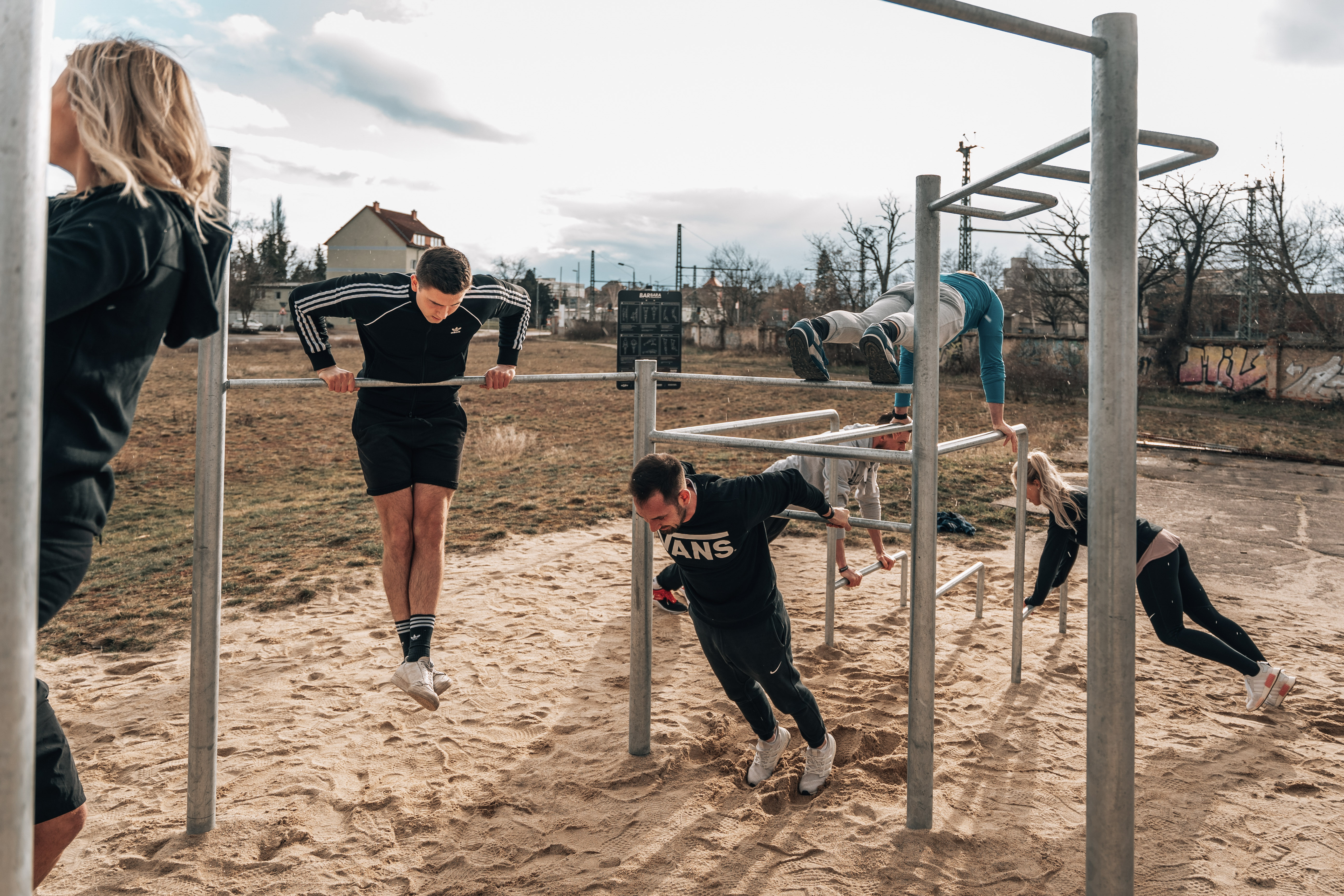
When a site survey reveals a courtyard of 30 square metres, a narrow strip between two buildings, or a school corner hemmed in by fencing, the instinctive response from many procurement teams is to abandon the idea of outdoor fitness altogether. That instinct is wrong—and BARbie exists to prove it.
What Is BARbie?
BARbie is the compact variant within the BARbara product family, developed by Workoutparks.com (GhettoWorkout e.V., Dessau). Where the full BARbara hexagon park is engineered to serve 8–12 users simultaneously across six exercise fields, BARbie scales the concept down to fit sites where a full hexagon footprint is simply not available.
The design philosophy is unchanged: every bar serves a concrete training purpose, bar geometry is athlete-grade (correct grip widths, correct dip-station heights, correct clearance for free swinging movements), and the structure is built to DIN EN 16630—the German and European safety standard for outdoor fitness equipment. What changes is the spatial envelope.
Important note: Exact dimensions and configuration details for BARbie are available on request from Workoutparks.com. This article describes the system's design principles and decision criteria; for site-specific planning data, contact the manufacturer directly.
Why Micro-Footprint Matters in Procurement
Space is money. In residential quarters, every square metre of courtyard is weighed against parking, green space, and play areas. In schools, the outdoor area is divided between sports fields, break zones, and access routes. In urban parks, planners balance seating, paths, and planting. A fitness installation that demands a large, unobstructed zone will lose the internal competition for space—regardless of its training value.
BARbie changes the calculus. By reducing the spatial requirement while preserving training quality, it opens up a category of sites that would otherwise be excluded from outdoor fitness provision entirely.
Typical BARbie Use Cases
| Site Type | Why BARbie Fits |
|---|---|
| Residential courtyard | Limited open area; residents want fitness without leaving the building complex |
| School corner or terrace | Tight perimeter; PE curriculum benefits from bodyweight training stations |
| Narrow public strip | Linear sites between paths, walls, or fences where a hexagon would not fit |
| Hotel or hostel terrace | Guests expect fitness amenity; outdoor space is premium |
| Small campsite pitch area | Campsite operators optimise every square metre for revenue-generating pitches |
| Urban pocket park | Municipality wants fitness provision in a small green space |
The BARbara Design Principles BARbie Inherits
Understanding BARbie requires understanding what makes BARbara different from generic outdoor fitness equipment—because BARbie carries those same principles into a smaller form factor.
Athlete-Grade Bar Geometry
GhettoWorkout e.V. spent years identifying the functional failures of playground-style calisthenics equipment: dip stations too low (forcing users to bend their knees), pull-up bars too narrow (limiting grip variation), elements positioned so close together that free swinging movements are blocked. BARbara—and by extension BARbie—was designed to eliminate every one of these compromises.
Before the system was finalised, the team surveyed calisthenics clubs across Germany to identify which elements were most wanted and which existing products failed to deliver. The result is a system where every bar earns its place.
DIN EN 16630 Compliance
Both BARbara and BARbie are built to DIN EN 16630, the European standard governing outdoor fitness equipment for public use. This matters for procurement in two ways:
- Legal certainty: Public operators—municipalities, schools, housing associations—require DIN EN 16630 compliance to meet their duty of care. A non-compliant installation creates liability exposure.
- Inspection readiness: Before a BARbara or BARbie installation opens to the public, a certified inspector must sign off on it. Annual functional inspections follow. The system is designed with this lifecycle in mind.
Material Variants
Like the full BARbara system, BARbie is available in three material specifications:
| Variant | Characteristics |
|---|---|
| Hot-dip galvanised | Classic steel construction, galvanised to the same standard as road signage. Decades of weather resistance without surface treatment. |
| Hot-dip galvanised + powder-coated | Adds a colour layer—club colours, municipal colour schemes, or park design concepts. |
| Stainless steel V2A | Premium variant. Fully weather-resistant, highest resistance to vandalism and corrosion. |
The choice of material variant affects both the investment level and the long-term maintenance profile. For high-traffic urban sites or coastal environments, stainless steel V2A is the technically sound choice. For sheltered courtyards with lower vandalism risk, hot-dip galvanised is a proven and cost-effective specification.
Structural Integrity
The BARbara family is engineered for robustness. Bolts are recessed and concealed within the structure—not exposed for easy removal. Once the posts are set in concrete foundations, the installation is designed to withstand significant lateral force. This is not incidental: outdoor fitness equipment in public spaces is subject to misuse, and a system that fails structurally creates both safety risk and replacement cost.
QR-Code Training System
Every BARbara and BARbie installation includes a signage panel with a QR code linking to structured training programmes at four levels: Beginner, Intermediate, 50+, and Pro. This is not a marketing feature—it is a functional one. It means that a resident who has never done a pull-up, a 60-year-old looking for low-impact strength training, and a trained athlete can all use the same installation productively. The QR system removes the barrier of not knowing what to do.
When to Choose BARbie Over BARbara
The decision between BARbie and the full BARbara hexagon park is primarily a function of available space and expected simultaneous user load.
If a site can accommodate the full hexagon footprint and the expected user group justifies 8–12 simultaneous users, BARbara is the right choice. Its hexagon geometry maximises training variety, creates a social training environment, and delivers the highest training density per installation.
If the site cannot accommodate the full hexagon—or if the expected simultaneous user count is lower—BARbie delivers the same training quality in a reduced footprint. It is not a compromise product; it is a correctly specified product for a different site condition.
Decision Checklist for Procurement Specialists
- Available footprint: Can the site accommodate the full BARbara hexagon? If not, BARbie is the appropriate specification.
- Expected simultaneous users: Is the site likely to see 8–12 users at once, or is the expected load lower? Lower load = BARbie is sufficient.
- Budget envelope: BARbara installations are available under EUR 15,000–20,000 depending on variant and configuration. Contact Workoutparks.com for BARbie-specific pricing.
- Material specification: Hot-dip galvanised, powder-coated, or stainless steel V2A—determined by site exposure and vandalism risk.
- Inspection and maintenance: Budget for pre-opening inspection by a certified inspector and annual functional checks thereafter.
Delivery and Installation
Workoutparks.com operates regional serial production in its home district in Germany. BARbie, like BARbara, is stocked as production inventory—not made to order with months-long lead times. For procurement teams working to seasonal deadlines (a campsite opening in spring, a school year starting in September), this is a material operational advantage.
Installation does not require specialist contractors. The system is designed so that a municipal maintenance team, a club's own members with basic construction skills, or a local landscaping firm can complete the installation. The tools required are standard workshop inventory.
Making the Case Internally
For procurement specialists presenting BARbie to decision-makers, the core argument is straightforward: this is not a scaled-down compromise—it is a correctly specified system for a constrained site. The training quality, the safety standard, the material durability, and the QR-guided user experience are identical to the full BARbara park. The only variable is the spatial footprint.
Sites that previously had no viable outdoor fitness option now have one. That is the value proposition of BARbie.
If you are evaluating BARbie for a specific site, the most productive next step is a direct conversation with the Workoutparks.com team. They can advise on configuration, material specification, and site-specific planning requirements. Contact the team at outdoorfitnessparks.com/contact to start the conversation.