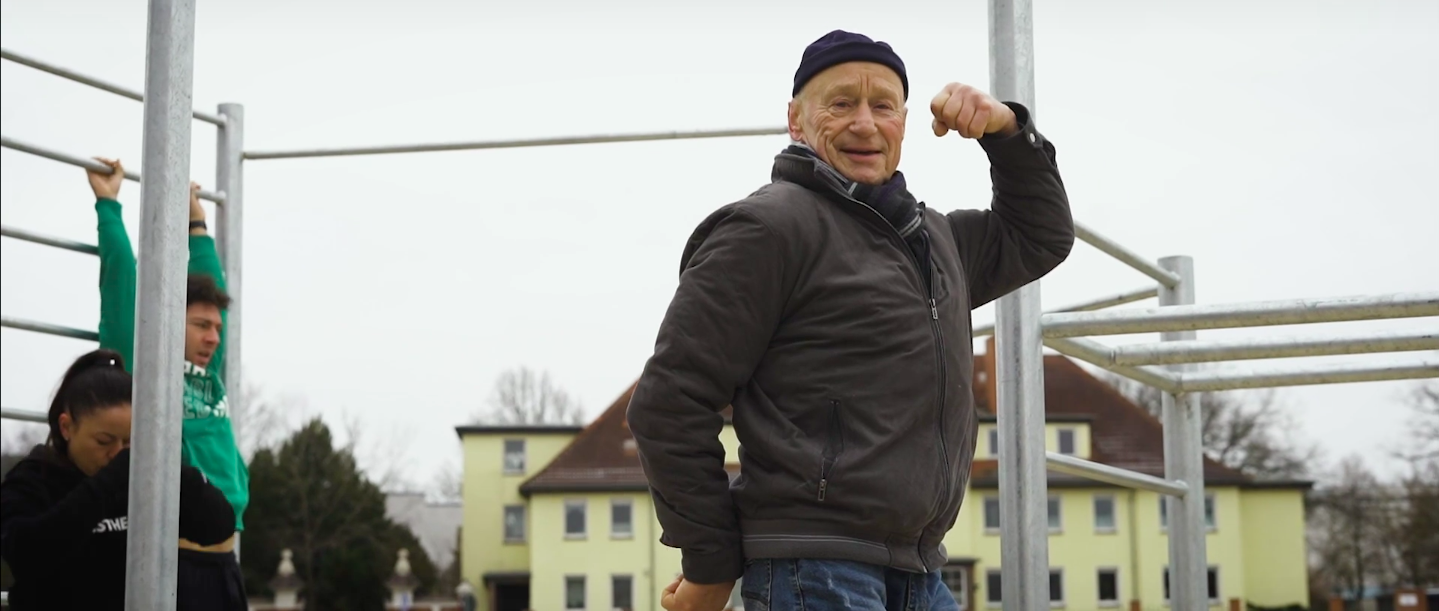
Healthy Aging: Preserving Muscle Mass, Mobility, and Balance on Outdoor Bars
After 40, the human body undergoes a gradual but measurable physiological shift. Muscle fibres atrophy at roughly 1–2% per year — a process clinicians call sarcopenia. Bone density decreases. Connective tissue loses elasticity. Proprioception becomes less precise, raising fall risk.
These changes are real, but not inevitable in their severity. Decades of exercise science confirm that consistent, progressive resistance training is the single most effective intervention for slowing — and in many cases partially reversing — age-related physical decline. The question is not whether to train, but how and where.
Outdoor calisthenics bars offer a compelling answer: a low-barrier, weather-resistant, socially accessible training environment that supports exactly the movement patterns the aging body needs most.
Why Muscle Mass Matters More After 40
Skeletal muscle is metabolically active tissue. It regulates blood glucose, supports joint stability, and generates the force needed for everyday tasks — climbing stairs, carrying groceries, rising from a chair. When muscle mass declines, these functions degrade in parallel.
Sarcopenia is not merely an aesthetic concern. Research consistently links low muscle mass in older adults to increased all-cause mortality, higher rates of type 2 diabetes, greater fall risk, and longer recovery times after illness or surgery. Preserving lean mass is, in a very real sense, preserving independence. The good news: muscle tissue responds to mechanical loading at any age — adults in their 60s and 70s can build measurable strength when training is consistent and appropriately challenging.
What Outdoor Bars Offer That Gym Machines Cannot
Conventional gym machines isolate single muscle groups through fixed movement paths — useful for rehabilitation, but insufficient for functional aging. Moving confidently through daily life requires compound, multi-joint movements that train coordination, balance, and strength simultaneously. Outdoor calisthenics bars deliver exactly this. Every major movement pattern is represented:
| Movement Pattern | Exercise on Outdoor Bars | Primary Muscles Trained |
|---|---|---|
| Vertical pull | Pull-up / assisted pull-up | Latissimus dorsi, biceps, rear deltoid |
| Vertical push | Dip / bench dip | Triceps, pectorals, anterior deltoid |
| Hip hinge / squat | Squat with Swedish ladder support | Quadriceps, glutes, hamstrings |
| Core anti-flexion | Knee raise / leg raise | Rectus abdominis, hip flexors |
| Horizontal push | Push-up on parallettes | Pectorals, triceps, serratus anterior |
| Scapular stability | Dead hang / scapular pull-up | Rotator cuff, lower trapezius |
Because these movements require the body to stabilise itself in space — rather than being supported by a machine seat — they simultaneously train the small stabilising muscles and the proprioceptive systems that protect joints and prevent falls.
The Three Pillars of Healthy Aging: Muscle, Mobility, Balance
1. Muscle Mass Preservation
Pull-ups and dips are among the most effective upper-body compound movements available. For adults who cannot yet perform a full pull-up, the flat bar (simplified pull-up station) allows a horizontal rowing movement that loads the same muscle groups with significantly reduced bodyweight demand. This scalability is critical: it means the same equipment serves a 45-year-old recreational athlete and a 68-year-old beginning their fitness journey.
Squats performed with the support of a Swedish ladder allow older adults to train the lower-body movement pattern safely, using the ladder for balance assistance as needed and gradually reducing reliance on it as strength improves.
2. Joint Mobility
Mobility — the active range of motion available at a joint — declines with age primarily due to reduced use, not irreversible structural change. Calisthenics movements performed through full range of motion are among the most effective mobility training tools available.
The dead hang, for example, decompresses the shoulder joint and lengthens the thoracic spine — two areas that become chronically compressed in adults who spend significant time seated. Dips, performed with controlled depth, maintain shoulder extension range. Knee raises train hip flexor strength through a full range that most adults rarely access in daily life.
Regular, full-range movement through these patterns counteracts the stiffening that characterises sedentary aging.
3. Balance and Proprioception
Balance training is often treated as a separate discipline — balance boards, single-leg stands, wobble cushions. But compound calisthenics movements inherently train balance because they require the body to stabilise itself dynamically. A pull-up requires the core to prevent the pelvis from swinging. A dip requires the shoulder girdle to stabilise under load. A squat requires the ankle, knee, and hip to coordinate in three planes simultaneously. This integrated proprioceptive demand is precisely what reduces fall risk in older adults — not isolated balance drills, but movement that trains the whole system.
Structured Progressions for Adults 40+
One of the most common barriers to outdoor fitness for older adults is uncertainty: What should I do? How hard should I push? Am I doing this safely?
The BARbara calisthenics park system, developed by GhettoWorkout e.V. from Dessau — a calisthenics association with over 13 years of practical experience — addresses this directly. Every installation includes a QR-code training system giving immediate access to structured programmes across four levels:
- Beginner — foundational movements, low load, emphasis on technique
- Intermediate — progressive overload, compound combinations
- 50+ (Ü50) — a dedicated programme for older adults, with appropriate volume, intensity, and joint-friendly exercise selection
- Pro — advanced calisthenics skills for experienced athletes
The 50+ programme is not a watered-down standard workout. It is a purpose-built training plan accounting for longer recovery times, reduced connective tissue elasticity, and the importance of controlled loading. Video demonstrations accompany each exercise, removing the guesswork for users new to bodyweight training.
Safety, Standards, and Equipment Quality
For older adults, equipment quality is a prerequisite for safe training. Bars that flex under load, grips that are too narrow, or stations at incorrect heights create injury risk that negates the benefits of training.
The BARbara system is built to DIN EN 16630, the European standard for outdoor fitness equipment, specifying structural load requirements, surface finish standards, and dimensional guidelines. Before any installation opens to the public, a certified inspector must formally approve it; annual functional inspections follow.
Three material variants are available — hot-dip galvanised steel, galvanised and powder-coated steel, and stainless steel V2A — all engineered for long-term outdoor durability. The hexagonal arrangement distributes structural loads efficiently, and the concealed bolt design prevents tampering. This is equipment built to last decades, not seasons.
The Social Dimension of Outdoor Training
Physical health and social connection are deeply intertwined in healthy aging research. Isolation is an independent risk factor for cognitive decline, depression, and reduced physical activity. Outdoor fitness parks create opportunities for incidental social interaction that indoor gyms rarely replicate.
The BARbara hexagon design places 8–12 users in close proximity, training simultaneously on different stations. This spatial arrangement naturally facilitates conversation and mutual encouragement — particularly valuable for adults 40 and older who may have reduced social contact compared to earlier life stages. Municipalities and housing developers who install outdoor fitness equipment are not merely providing exercise infrastructure. They are creating social infrastructure.
Practical Considerations for Operators
For municipalities, housing associations, and health-focused organisations, key practical factors include:
- No ongoing operating costs: no electricity, heating, or staffing required — only the annual inspection.
- Year-round availability: calisthenics bars are usable in all weather conditions.
- Compact footprint: the BARbara hexagon delivers six exercise stations within a minimal ground area.
- Investment range: under EUR 15,000–20,000 depending on material variant and configuration.
- Fast delivery: regional serial production in Germany means stock availability without months-long lead times.
Conclusion: The Case for Outdoor Bars in Healthy Aging Strategy
The evidence for resistance training as a cornerstone of healthy aging is unambiguous. The practical barriers — cost, access, complexity, social anxiety — are real but surmountable. Outdoor calisthenics bars address each directly: free to use, publicly accessible, structured through QR-code guidance, and inherently social.
For adults 40 and older, the outdoor bar is not a compromise. It is, in many respects, the optimal training environment — one that trains muscle, mobility, and balance simultaneously, in fresh air, without the overhead of a gym membership.
Contact the OutdoorFitnessParks team to discuss your project, site requirements, and the right configuration for your community.