Why Health-Conscious Travelers Are Reshaping the Camping Market
The modern camper is not the same guest who arrived a decade ago. Today's RV traveler and glamping guest increasingly prioritizes active lifestyles, outdoor movement, and wellness — not just a place to park or sleep. Research across the European camping sector consistently shows that fitness and sport amenities rank among the top factors influencing campsite selection, particularly for guests aged 30–55.
This shift creates a concrete commercial opportunity for campground operators and holiday park managers: invest in the right outdoor fitness infrastructure and you attract a higher-value, health-conscious demographic that books longer stays, returns more often, and recommends your site to peers.
The question is not whether to add fitness amenities — it is which solution delivers the best return on a limited footprint.
The Problem with Conventional Fitness Solutions at Campsites
Most campsite operators who have explored fitness amenities encounter the same obstacles:
- Indoor gyms require a dedicated building, electricity, climate control, and ongoing equipment maintenance. Capital costs are high; operational costs never stop.
- Single-station fitness trails scatter equipment across large areas, reducing the social dynamic and requiring more land.
- Playground-style fitness equipment from general suppliers often fails athletes: incorrect bar heights, wrong grip widths, and obstructed swing paths make serious training impossible.
What campsite guests who train regularly actually need is a compact, weather-proof, low-maintenance system that supports a full-body workout — without requiring staff supervision or electricity.
Outdoor Calisthenics Parks: The Campsite-Ready Solution
A calisthenics park built to the DIN EN 16630 outdoor fitness equipment standard delivers exactly that. DIN EN 16630 is the European norm governing the design, materials, and safety of permanently installed outdoor fitness equipment — compliance is mandatory for public and semi-public installations across Germany and increasingly referenced across the EU.
The BARbara system, developed by GhettoWorkout e.V. (Dessau, founded 2012, calisthenics since 2013), was designed from the ground up by competitive athletes who identified the functional failures of existing market products. Before finalizing the design, the team surveyed calisthenics clubs across Germany to determine which exercise elements were most needed and what existing equipment got wrong.
The result is a hexagon-shaped modular park — inspired by the structural efficiency of a honeycomb — that packs six distinct exercise fields into a single, compact footprint:
| Field | Equipment | Primary Exercises |
|---|---|---|
| A | Squat rack / Swedish ladder | Squats, step-ups, incline work |
| B | Pull-up bar | Pull-ups, chin-ups, hanging |
| C | Low horizontal bar | Assisted pull-ups, rows |
| D | Dip bars | Dips, L-sits, tricep work |
| E | Push-up parallettes | Push-ups, planche progressions |
| F | Knee raise / Snake Bar | Core work, knee raises, hanging |
This configuration supports a complete upper-body, lower-body, and core training session — without a single piece of electrical equipment.
Why the Hexagon Design Works for Campsites
Space efficiency is the defining constraint for most campsite operators. Every square meter allocated to a fitness station is a square meter not generating revenue from a pitch or glamping unit.
The BARbara hexagon addresses this directly:
- Minimal footprint, maximum content. The hexagonal arrangement shares structural posts between adjacent exercise fields, meaning more training stations per square meter than any linear layout.
- Fewer foundations. Shared posts reduce the number of concrete foundations required, lowering installation cost and groundwork disruption.
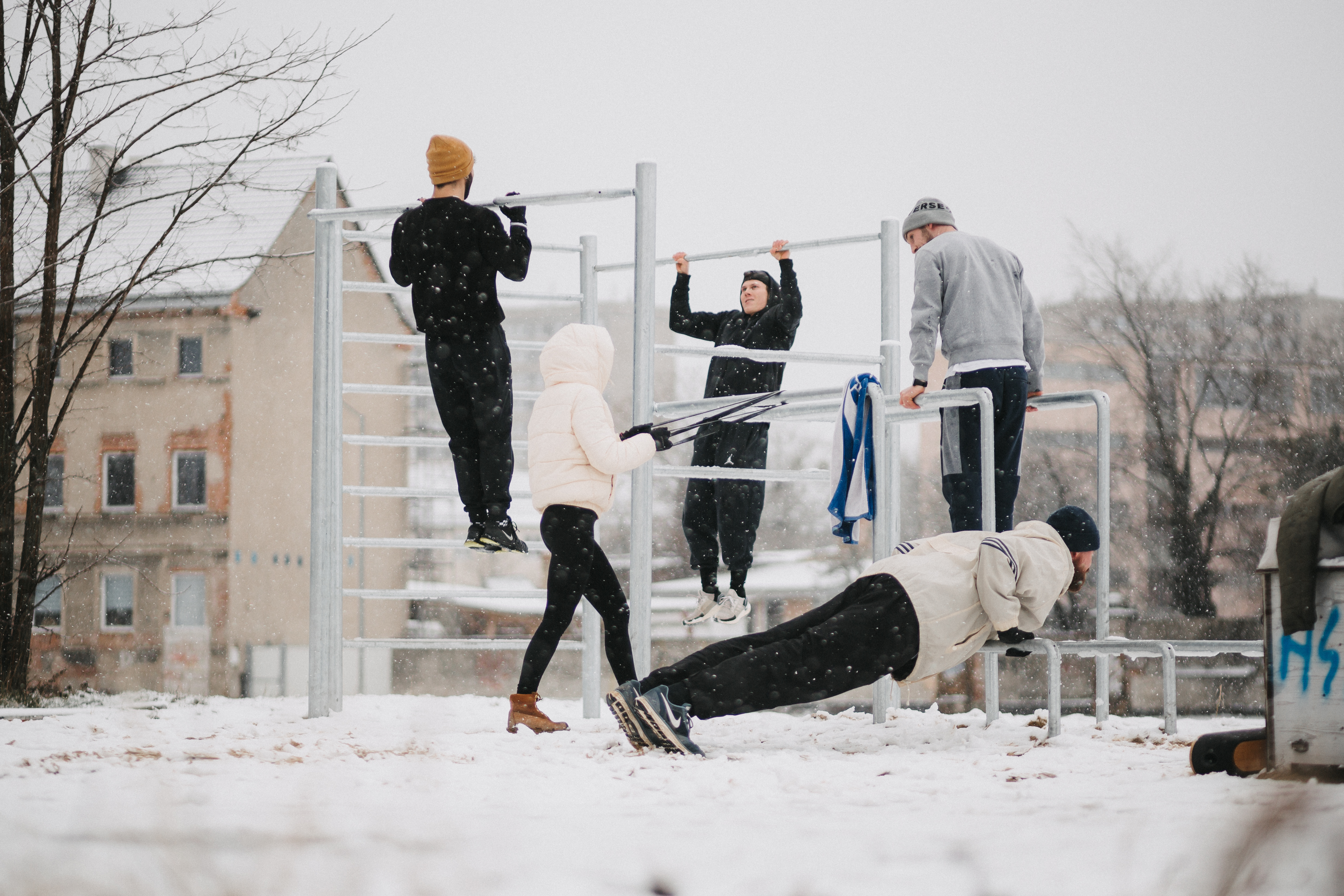
- Group training in one spot. Eight to twelve people can train simultaneously within the hexagon — a social dynamic that encourages use and creates visible activity that attracts other guests.
- No electricity, no running costs. No power connection, no heating, no staff required. The installation operates 365 days a year with only periodic visual inspections and an annual functional check as required by DIN EN 16630.
Material Variants: Matching Your Site's Aesthetic and Climate
BARbara is available in three material configurations, allowing operators to match the installation to their site's visual identity and environmental conditions:
| Variant | Finish | Best For |
|---|---|---|
| Hot-dip galvanized | Raw steel, zinc-coated | High-durability, cost-effective, decades of weather resistance |
| Galvanized + powder-coated | Color finish over galvanized base | Brand alignment, club colors, park color schemes |
| Stainless steel V2A | Full stainless construction | Coastal or high-humidity environments, premium aesthetic |
The powder-coated variant is particularly relevant for glamping resorts and branded holiday parks where visual consistency matters. The stainless steel V2A option is the most vandalism-resistant and requires the least maintenance over a 20-year horizon.
The QR-Code Training System: Guests Don't Need to Be Athletes
One of the most common objections from campsite operators is: "Our guests aren't calisthenics athletes — they won't know how to use it."
BARbara addresses this with an integrated QR-code training system on every information panel. Guests scan the code and access structured workout programs at four levels:
- Beginner — no prior experience required
- Intermediate — for regular gym-goers transitioning to bodyweight training
- 50+ (Ü50) — age-appropriate progressions for older adults
- Pro — advanced calisthenics movements for experienced athletes
Each level includes instructional videos for individual exercises. A guest who has never done a pull-up can follow the beginner program from day one. A guest who trains five days a week at home can continue their routine without compromise.
This breadth of accessibility is critical for campsite deployments: your guest demographic spans families, retirees, solo travelers, and serious athletes. One installation serves all of them.
Commercial Impact: What Operators Gain
Adding a BARbara calisthenics park to an RV park or glamping resort delivers measurable commercial benefits:
Differentiation in a competitive market. The majority of campsites in Germany and across Europe do not yet offer a dedicated outdoor fitness installation. Early adopters position themselves as modern, sport-friendly destinations — a meaningful differentiator in online search and booking platforms.
ADAC campsite classification. For German campsite operators, the ADAC campsite rating system explicitly evaluates sport and fitness offerings. A certified outdoor fitness installation can positively influence star classification, which directly affects booking volume and pricing power.
Social media visibility. Guests who train share their workouts. A visually distinctive hexagonal calisthenics park generates organic social media content — free marketing that reaches exactly the health-conscious demographic you want to attract.
Tax deductibility. The investment qualifies as a business expense and can be deducted accordingly — reducing the effective net cost of the installation.
Price indicator. A BARbara installation can be realized for under EUR 15,000 to under EUR 20,000 depending on the material variant and configuration. For a campsite generating revenue from dozens of pitches, the payback period is short.
Installation: Fast, Simple, No Specialist Equipment
Campsite operators frequently cite installation complexity as a barrier. BARbara was designed to eliminate this concern:
- No specialist equipment required. Standard tools available in any maintenance workshop are sufficient.
- Your own staff can install it. A campsite maintenance team or a local landscaping contractor — the kind of firm most campsites already work with — can complete the installation.
- Serial production means stock availability. BARbara is manufactured in regional serial production in Germany, which means units are available from stock. There are no months-long lead times. A campsite operator who decides in spring can have the installation ready before peak season.
- Certified inspection before opening. DIN EN 16630 requires a certified inspector to sign off before the installation opens to the public. After that, annual functional inspections and regular visual checks are the only ongoing obligations.
Getting Started
If you manage an RV park, glamping resort, or holiday park and want to understand what a BARbara installation would look like on your site — footprint, material options, configuration, and indicative cost — the right next step is a direct consultation.
Visit outdoorfitnessparks.com/contact to request a no-obligation planning conversation. Bring your site dimensions and guest profile; the team will work through the configuration options with you.